
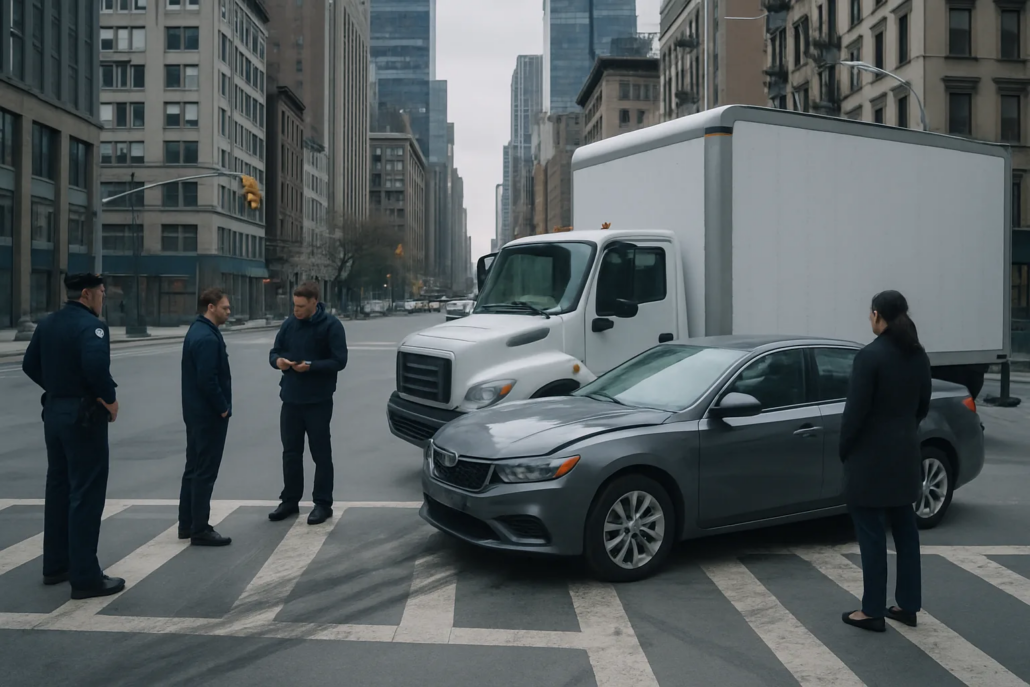
Can Comparative Negligence Reduce a New York Truck Claim?
A collision between a commercial truck and a passenger vehicle can leave an injured driver wondering whether an alleged mistake will eliminate the entire claim. In New York, that is not necessarily how comparative negligence works. New York truck accident comparative negligence generally concerns how responsibility is divided when more than one person or entity may have contributed to a crash.
For readers in New York, NY, Neumann provides practical guidance about the evidence used to evaluate allegations involving speed, lane position, visibility, braking, and reaction time. This article explains how a fault percentage may affect compensation, why the first version of events may not be complete, and how evidence to preserve after a New York truck crash can influence the evaluation.
How New York Truck Accident Comparative Negligence Works
New York generally follows a comparative negligence approach. If an injured person is found partly responsible for an accident, the damages awarded in a personal injury claim may be reduced by that person’s assigned percentage of fault. The precise effect depends on the facts, the claims asserted, and the evidence presented.
That means a claim is not automatically defeated because an insurer or truck company argues that the passenger-car driver was speeding, moved into a truck’s lane, failed to see a hazard, or did not brake soon enough. The allegation must be evaluated against the full sequence of events.
Fault Is an Evidence Question
A shared-fault truck accident in New York may involve disputed questions such as:
- How fast were the vehicles traveling?
- Was either vehicle changing lanes or following too closely?
- Did lighting, weather, road design, or an obstruction affect visibility?
- When did each driver perceive the danger, and what braking or steering response was possible?
- Did the truck’s size, stopping distance, load, or equipment condition affect the collision?
A fact finder may assign different percentages to different parties. A driver’s alleged mistake may matter, but it is only one part of the analysis. In New York, NY, photographs, measurements, witness accounts, and vehicle damage may help test whether an allegation fits the physical evidence.

What Evidence Can Affect a Shared-Fault Decision?
The most useful evidence often comes from the moments before impact. Promptly preserving evidence to preserve after a New York truck crash may help clarify lane positions, traffic signals, sightlines, skid marks, impact points, and the condition of both vehicles. Dash-camera footage, nearby traffic-camera recordings, cell-phone records when legally obtainable, and independent witness statements may also become relevant.
Vehicle damage can provide clues about direction, speed, angle, and the location of an impact, although photographs alone may not answer every question. An accident-reconstruction professional may compare those clues with roadway geometry, event-data information, braking marks, and testimony. In a serious truck crash, analysis may be especially important when the parties offer conflicting accounts.
How Trucking Rules May Influence Comparative Fault
Commercial carriers and drivers may be subject to safety requirements involving inspections, equipment, loading, and hours of service. Evidence concerning federal trucking rules that may provide evidence in a New York crash claim may support an argument about negligence, but a regulatory violation does not automatically decide every issue of liability. It also does not necessarily eliminate questions about the passenger vehicle’s conduct.
Similarly, a claim that a driver failed to brake should be examined alongside mechanical evidence. Brake, tire, steering, coupling, or other failures may require investigation into maintenance history and whether the truck could have avoided the impact. Defective truck parts that may contribute to a New York crash can complicate an account that places responsibility on a driver alone.
How Fault Allegations Affect a New York Truck Injury Claim
Insurance companies may investigate a collision from different perspectives, particularly when the truck operator, carrier, owner, maintenance provider, or cargo-related business has separate coverage. After a crash, multiple insurers after a New York truck collision may each ask for statements, records, or authorizations. An insurer’s statement that an injured driver bears a particular percentage of fault is an allegation to assess, not necessarily a final determination.
Can More Than Two Parties Share Fault?
Yes. Depending on the facts, responsibility may be considered for:
- The truck driver’s speed, attention, lane position, or response;
- The motor carrier’s hiring, supervision, scheduling, or safety practices;
- A maintenance provider’s work or inspection decisions;
- A shipper or loader’s handling of cargo; and
- A manufacturer or supplier when a component failure is relevant.
For example, load shifts and braking evidence in a New York jackknife crash may help explain whether cargo balance, braking, road conditions, and vehicle dynamics contributed to a collision. The purpose of this analysis is not to assign blame by assumption. It is to identify which facts may support or challenge each proposed percentage of responsibility.
Does Alleged Shared Fault Stop Medical-Bill Benefits?
A fault dispute does not necessarily answer how eligible medical expenses are handled immediately after a New York collision. No-fault benefits and a bodily-injury claim are separate issues, subject to applicable eligibility rules, documentation, and limits. Information about medical bills and no-fault benefits after a New York truck accident may help readers understand that an insurer’s comparative-fault position does not automatically resolve every payment question. A closer look at this related topic is available in Who Pays Medical Bills After a New York Truck Accident?.
What Mistakes Can Weaken a Shared-Fault Evaluation?
People involved in a truck collision may unintentionally make the later investigation harder. Common problems include giving a detailed recorded statement before the facts are assembled, posting about the crash or injuries online, failing to preserve damaged property, or assuming that a police report conclusively determines civil liability. A report can be important, but it may not contain every relevant fact or reflect later-discovered evidence.
Prompt investigation can matter because vehicles may be repaired or sold, camera footage may be overwritten, and witnesses’ memories may change. Deadlines for a New York truck injury claim may vary by claim type and the parties involved. An attorney evaluating a New York, NY collision may consider how to identify insurers, preserve electronic data, document medical care, and investigate fault before relevant deadlines expire.
Generally speaking, a consultation may help clarify what evidence exists and how the alleged conduct of each driver should be evaluated. It may also help distinguish a temporary uncertainty about fault from a conclusion that a claim has no legal basis.
Frequently Asked Questions
If I was speeding slightly, can I still bring a New York truck accident claim?
Possibly. A person’s speed may be relevant to whether that conduct contributed to the collision and to the percentage of comparative negligence assigned. It does not automatically eliminate a claim. The analysis may consider the speed, the road and traffic conditions, the truck’s conduct, the timing of the hazard, and whether the collision or injuries would have occurred without that conduct. The available evidence is important.
Can a police report decide who is at fault in a truck crash?
A police report may contain useful observations, statements, diagrams, or citations, but it is not necessarily the final word on civil liability in New York. Officers may not witness the impact, and a report may not address vehicle data, mechanical conditions, cargo, or later testimony. Insurers, attorneys, experts, and courts may evaluate additional evidence when considering a truck crash passenger-car fault dispute.
What if the truck driver says I changed lanes into the truck?
That allegation should be compared with all available evidence rather than accepted or rejected automatically. Photographs, impact damage, lane markings, witness accounts, camera footage, vehicle data, and the timing of steering or braking may help reconstruct the vehicles’ positions. Visibility, blind spots, traffic conditions, and whether the truck was also changing lanes may be relevant. An attorney may evaluate the complete record before advising on the claim.
Does New York assign one fault percentage to everyone involved?
Not necessarily. A New York injury claim may involve more than two potentially responsible parties, including a truck driver, carrier, maintenance provider, loader, or component manufacturer. The allocation depends on the evidence and the legal issues presented. Different claims may also involve different rules concerning responsibility, damages, insurance, and proof. A fact-specific review is generally needed to understand how percentages may affect recovery.
How Neumann Can Help
Neumann is dedicated to examining the facts behind truck and auto collisions rather than assuming that an injured driver’s alleged mistake tells the whole story. The firm is committed to fighting for a fair evaluation of issues such as speed, lane position, visibility, braking, vehicle damage, trucking records, mechanical conditions, and the conduct of other potentially responsible parties.
The team is ready to evaluate your situation, explain how comparative negligence may relate to your claim, and discuss available legal options in New York, NY. Contact Neumann for a free consultation or case evaluation. No outcome is guaranteed, and each matter depends on its specific facts and applicable law.
The information in this article is for educational purposes only and does not constitute legal advice. Contact a qualified attorney licensed in New York, NY for advice specific to your situation.


Leave a Reply
Want to join the discussion?Feel free to contribute!